Two Hands Ultherapy Prime & Aesthetic Lifting Clinic in Gangnam, Seoul · 1:1 Physician Care
Ultherapy & Sofwave Specialized Clinic · Gangnam-daero
en-US


Clinical Guide
New M-Cell vs PRP vs Traditional Hair Loss Treatments: A Comparison Guide
Compare New M-Cell, PRP, and traditional hair loss treatments such as minoxidil and finasteride, including FDA status, evidence, and what to expect.
Schedule a ConsultationNew M-Cell vs PRP vs Traditional Hair Loss Treatments: A Comparison Guide
Medically reviewed by Dr. Choi Chang Won, Chief Medical Director, Maison de M Clinic
If you are researching hair loss treatments, you have probably run into three very different categories of options: regenerative injectables such as the New M-Cell therapy offered at Maison de M Clinic in Seoul, platelet-rich plasma (PRP) injections, and traditional, evidence-based medical treatments such as minoxidil and finasteride. These approaches differ not only in how they work but also in how they are regulated, how much research supports them, and what a reasonable person should expect from them. This guide compares them neutrally so that you can have a more informed conversation with a qualified clinician.
Two ideas run through everything that follows. First, hair loss has many possible causes, so identifying the underlying cause through a proper diagnosis matters far more than choosing a treatment on your own. Second, no responsible clinic or clinician can guarantee regrowth; results vary from person to person, and honest expectations are part of good care. With that framing in place, let us look at each category in turn.

Why diagnosis comes before any treatment
Before comparing treatments, it is worth emphasizing why a diagnosis has to come first. As Mayo Clinic explains, hair loss can result from heredity, hormonal changes, medical conditions, certain medications and supplements, radiation therapy, a stressful event, and hairstyling practices, among other factors. The most common form is hereditary pattern hair loss, known medically as androgenetic alopecia, but thinning can also reflect thyroid disorders, iron deficiency, autoimmune conditions such as alopecia areata, scarring conditions, or a temporary shedding phase called telogen effluvium.
This matters because the "right" treatment depends entirely on the cause. A therapy that might be discussed for pattern hair loss may be inappropriate — or even counterproductive — for a scarring alopecia or an untreated medical condition. According to StatPearls, androgenetic alopecia is driven in genetically susceptible people by the effect of androgens on hair follicles, gradually shrinking (miniaturizing) follicles so that hairs become finer and shorter over successive growth cycles. A clinician evaluates your pattern, history, and sometimes blood work or a scalp examination before recommending anything. Skipping that step and jumping straight to an injectable or a supplement risks treating the wrong problem.
Category 1: New M-Cell (a branded regenerative therapy)
New M-Cell is the name Maison de M Clinic uses for an autologous blood-cell regenerative therapy. "Autologous" means the material comes from your own body. According to the clinic, a small volume of the patient's blood is collected, processed the same day using the clinic's protocol without laboratory cell culture, and then administered as part of a regenerative treatment plan. For hair concerns, one delivery method is a scalp injection that the clinic describes as customized to each person's scalp condition and the physician's assessment.
It is important to be precise about how a branded regenerative offering like this is regulated. New M-Cell is a clinic offering, and it should not be understood as a U.S. Food and Drug Administration (FDA)–approved treatment for hair loss. A device used to process blood inside a clinic may hold an FDA clearance as a piece of equipment, but a device clearance is not the same as FDA approval of a specific therapy as safe and effective for regrowing hair. Likewise, approvals or registrations under other systems — for example Korea's Ministry of Food and Drug Safety (MFDS) or Europe's CE marking — are not equivalent to U.S. FDA approval and should not be presented as such.
The FDA has issued a consumer alert on regenerative medicine products, including stem cell and exosome products, cautioning that there is a great deal of misleading information online, that many such products have not been proven safe or effective for the conditions being advertised, and that some may carry meaningful safety risks. Maison de M Clinic's own materials reflect a similarly measured stance: the clinic states that no guarantee of therapeutic outcome or disease-specific benefit is made, and it lists situations in which the treatment may not be suitable, including active scalp infections, severe inflammation or untreated scalp conditions, certain medical conditions or medications, pregnancy or breastfeeding, and advanced hair loss that would more appropriately be addressed with surgical restoration. Any changes, the clinic notes, tend to develop gradually, and maintenance sessions may be discussed.
The sensible way to view New M-Cell is as an elective, individualized option a clinic offers — described generically as an autologous blood-derived scalp injection — rather than as a proven or guaranteed solution. If you are considering it, ask the clinic directly what the treatment is expected to achieve, what evidence supports it, and what the risks are, and weigh that against the FDA's cautions.
Category 2: PRP (platelet-rich plasma)
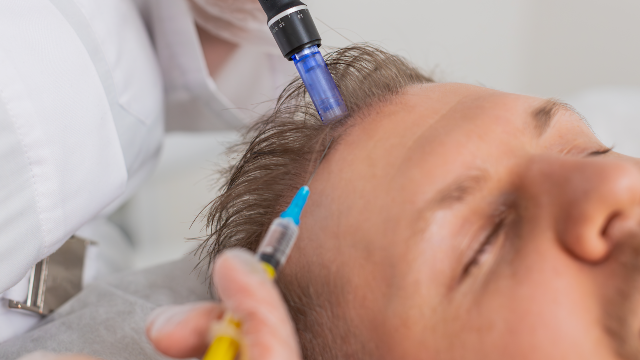
Platelet-rich plasma is the most widely studied member of the blood-derived injectable family. Blood is drawn, spun in a centrifuge to concentrate platelets, and the resulting plasma is injected into the scalp. The theory is that growth factors concentrated in platelets may support the hair-growth environment.
For U.S. readers, one point deserves emphasis: PRP for hair loss is not FDA-approved. It is considered investigational. PRP preparation is not standardized across clinics — the volume of blood, the spin protocol, the concentration of platelets, the injection depth, and the treatment schedule all vary — which makes it difficult to compare results from one study or clinic to another. Published research on PRP for pattern hair loss has reported mixed findings for this reason, and reviewers repeatedly point to the lack of standardization as a barrier to firm conclusions.
New M-Cell and PRP are related in concept — both start from the patient's own blood — but they are not identical. The clinic describes New M-Cell as using minimally manipulated blood cells prepared without cell culture, using its own protocol, whereas PRP specifically refers to concentrated platelets in plasma. Neither is an FDA-approved hair-loss treatment, and both fall under the general caution the FDA raises about products marketed as regenerative. As with any injection, temporary redness, swelling, bruising, tenderness, or discomfort at the injection site is possible, and infection or bleeding is possible although uncommon with proper sterile technique.
Category 3: Traditional, evidence-based treatments
The third category is the one with the longest track record and the clearest regulatory status in the United States.
Minoxidil is available over the counter (OTC) in topical form and is FDA-approved for certain patterns of hair loss. It is applied to the scalp and is thought to prolong the growth phase of the hair cycle. It generally needs to be used continuously to maintain any benefit, and shedding sometimes increases briefly when starting. StatPearls describes topical minoxidil as a first-line option frequently discussed for androgenetic alopecia.
Finasteride is a prescription (Rx) oral medication that is FDA-approved for male pattern hair loss. It works by reducing levels of the hormone dihydrotestosterone (DHT), which is implicated in follicle miniaturization in androgenetic alopecia. Because it is a prescription drug with potential side effects and important considerations — including that it is not appropriate for use during pregnancy — it must be prescribed and monitored by a clinician. It is not indicated for all patients, which is another reason diagnosis and medical supervision matter.
Low-level laser therapy (LLLT) devices — such as certain laser combs, caps, and helmets marketed for home use — represent another category. Some of these devices have been FDA-cleared for promoting hair growth in specific patterns of hair loss. As with the energy devices discussed elsewhere in aesthetics, "cleared" refers to the device and its indicated use; it is not a promise of a specific result for an individual.
Beyond medications and devices, surgical hair restoration (hair transplantation) is a separate, well-established path for suitable candidates. The American Society of Plastic Surgeons (ASPS) describes hair transplantation as a surgical procedure that moves hair follicles from areas of denser growth to thinning areas, and notes that outcomes and candidacy depend on the individual. Surgery is a different order of intervention from injections or topical medications and is typically considered for more advanced or well-defined patterns.
Putting the three categories side by side
A few comparisons help organize the choice, always keeping in mind that only a clinician who has examined you can advise on your situation:
- Regulatory status. Minoxidil (OTC) and finasteride (Rx) are FDA-approved for certain patterns of hair loss; some LLLT devices are FDA-cleared. PRP for hair loss is not FDA-approved and is considered investigational. New M-Cell is a branded regenerative offering that is not FDA-approved for hair loss; equipment clearance and non-U.S. registrations (MFDS/CE) are not equivalent to U.S. FDA approval of the therapy.
- Evidence base. Traditional medications have the most established, standardized evidence. PRP has a growing but mixed and non-standardized body of research. Branded regenerative injectables generally have limited comparative evidence and should be viewed cautiously.
- What is involved. Minoxidil is topical and self-applied; finasteride is an oral prescription; LLLT devices are used at home or in clinic; PRP and New M-Cell are in-clinic injection procedures; transplantation is surgery.
- Expectations. None of these guarantees regrowth. Medications generally require ongoing use to maintain any benefit, injectable results (if any) develop gradually, and all outcomes vary by person and by the underlying cause.
Many clinicians think in terms of combinations and staging rather than a single "winner," and the appropriate plan depends on your diagnosis, your goals, your medical history, and your preferences. Maison de M Clinic is located in Seocho-gu, Seoul, and provides English-language support for international patients; you can learn more about the team on the clinic's about page or arrange an individualized discussion through its contact page.
What none of these treatments can promise
Whatever category you consider, be wary of language like "cure," "permanent," "guaranteed," or "100%." Hair biology is complex, hair loss is often progressive, and even the best-established treatments manage the condition rather than eliminate it. Continuous use is frequently required to maintain any benefit from medications, and injectable results — where they occur — tend to be gradual and variable. A responsible consultation focuses on what is realistic for your specific diagnosis, not on promises.
Bottom Line
- Diagnosis comes first. Hair loss has many causes, and the right approach depends on identifying the cause with a qualified clinician before choosing any treatment.
- Traditional options are the evidence-based baseline. Minoxidil (OTC) and finasteride (Rx) are FDA-approved for certain patterns of hair loss, and some low-level laser devices are FDA-cleared.
- PRP is investigational. PRP for hair loss is not FDA-approved, and its preparation is not standardized, which is why research findings are mixed.
- New M-Cell is a branded regenerative offering. It is not FDA-approved for hair loss; equipment clearance and non-U.S. registrations (MFDS/CE) are not the same as U.S. FDA approval, and the FDA cautions about regenerative-medicine products generally.
- No regrowth is guaranteed. Results vary, develop gradually if at all, and are best discussed in an in-person consultation.
Frequently Asked Questions
**Is New M-Cell FDA-approved for hair loss?**No. New M-Cell is a branded, autologous blood-derived regenerative therapy offered by the clinic. It is not an FDA-approved treatment for hair loss. A device used to process blood may hold FDA clearance as equipment, but that is not approval of the therapy as effective for regrowing hair, and approvals under Korea's MFDS or Europe's CE marking are not equivalent to U.S. FDA approval.
**Is PRP FDA-approved for hair loss?**No. PRP for hair loss is considered investigational and is not FDA-approved. Because PRP preparation is not standardized between clinics, published research has reported mixed results, and outcomes cannot be guaranteed.
**Which traditional treatments are actually FDA-approved?**Topical minoxidil (available over the counter) and oral finasteride (a prescription medication) are FDA-approved for certain patterns of hair loss. Some low-level laser therapy devices are FDA-cleared for promoting hair growth. Whether any of these is appropriate for you depends on your diagnosis and should be decided with a clinician.
**How do I know which option is right for me?**There is no universal answer. The suitable approach depends on the cause of your hair loss, your medical history, your goals, and a clinician's examination. That is why a proper diagnosis, rather than self-selection of a treatment, is the essential first step.
**Can these approaches be combined?**Sometimes clinicians discuss combinations or staged plans rather than a single treatment, depending on the diagnosis and the individual. Any combination should be decided by a qualified clinician who has evaluated you, and it does not change the fact that no outcome can be guaranteed.
This article is for general informational purposes and does not constitute individualized medical advice. Consult a qualified physician about your specific condition.
References
- Mayo Clinic — Hair loss (Symptoms and causes)
- StatPearls — Androgenetic Alopecia (NCBI Bookshelf)
- American Society of Plastic Surgeons — Hair Transplantation and Restoration
- U.S. Food and Drug Administration — Consumer Alert on Regenerative Medicine Products Including Stem Cells and Exosomes
More Clinical Articles
Continue reading physician-informed guides on non-surgical lifting, skin texture renewal, and aftercare in Seoul.
CellExosome BLACKLABEL: Exosome Skin Care at Maison de M
An evidence-cautious look at CellExosome BLACKLABEL exosome skin treatments at Maison de M Clinic in Seoul, and why exosome products are not FDA-approved.
Learn More
Sofwave and Thermage for Deeper Skin Tones: A Guide
How energy-based lifting devices Sofwave and Thermage work, and how clinicians tailor treatment for Latina, Mediterranean and deeper skin tones.
Learn More

Pting Laser vs CO2 Laser: Pain Scores and Recovery Benchmarks from KR
Pting Laser vs CO2 Laser: Pain Scores and Recovery Benchmarks from KR
Learn More