Two Hands Ultherapy Prime & Aesthetic Lifting Clinic in Gangnam, Seoul · 1:1 Physician Care
Ultherapy & Sofwave Specialized Clinic · Gangnam-daero
en-US


Premium Skin Rejuvenation · Consultation Required
Fascella
Fascella is a non-invasive fascia lifting treatment designed to improve skin elasticity and body contours by addressing deeper structural layers of the skin.
Schedule a Consultation
Advanced Fascia Lifting for Natural Contouring and Skin Elasticity
Overview of Fascella
Fascella is a non-invasive fascia lifting treatment designed to improve skin elasticity and body contours by addressing deeper structural layers of the skin. Unlike surface-focused aesthetic procedures, Fascella works on the SMAS layer, retaining ligaments, and the deep fascia, which play a critical role in maintaining facial structure and tissue support.
At Maison de M Clinic, Fascella is used as a method to promote natural lifting and shaping in a single treatment approach. The technology delivers RF (radiofrequency) and LF (low-frequency) energy together with a specialized MFR tool, allowing energy to reach deeper layers without requiring anesthesia or causing significant discomfort.
By stimulating the fascia and surrounding tissues, Fascella encourages the body’s natural regenerative processes. The treatment promotes collagen and elastin production, improves circulation, and supports healthier tissue structure.
Through this mechanism, Fascella helps restore skin elasticity, facial definition, and smoother body contours while maintaining a natural appearance.
Understanding Fascia and Its Role in Skin Structure
The fascia is a network of connective tissue that supports muscles, fat, blood vessels, and skin. Over time, factors such as aging, lifestyle, and mechanical tension may affect the condition of this layer. When fascia becomes tight or irregularly arranged, it can contribute to changes in skin firmness, contour irregularities, and visible cellulite.
Fascella targets these deeper layers directly.
The treatment focuses on three important anatomical structures:
- SMAS Layer (Superficial Musculoaponeurotic System) – the structural layer commonly associated with lifting treatments
- Retaining Ligaments – connective structures that maintain facial shape and tissue support
- Deep Fascia – the supportive layer beneath the skin that influences overall tissue tension and structure
By addressing these layers, Fascella supports fascia remodeling, which helps improve the overall condition of the skin and underlying tissues.
Conditions Treated with Fascella
At Maison de M Clinic, Fascella may be used to address several aesthetic concerns related to skin elasticity, tissue structure, and body contouring.
Cellulite and Stretch Marks
Cellulite and stretch marks can occur when connective tissue and fat distribution change beneath the skin. Fascella works by stimulating fascia and surrounding tissues, which may help improve skin texture and reduce the appearance of uneven surface contours.
Double Chin
Excess fat and changes in tissue elasticity under the chin can contribute to the appearance of a double chin. Fascella stimulates deeper tissue layers and the subcutaneous fat layer, supporting contour improvement in this area.
Swelling, Bruising, and Scar Tissue
Circulation and lymphatic flow play important roles in tissue recovery and appearance. Fascella stimulates the lymphatic system and blood vessels, which may help support the management of swelling, bruising, and scar tissue.
Loss of Skin Elasticity
Reduced collagen and elastin production over time can lead to skin laxity. Fascella encourages the regeneration of these structural proteins, supporting improved firmness and elasticity.
How Fascella Treatment Works
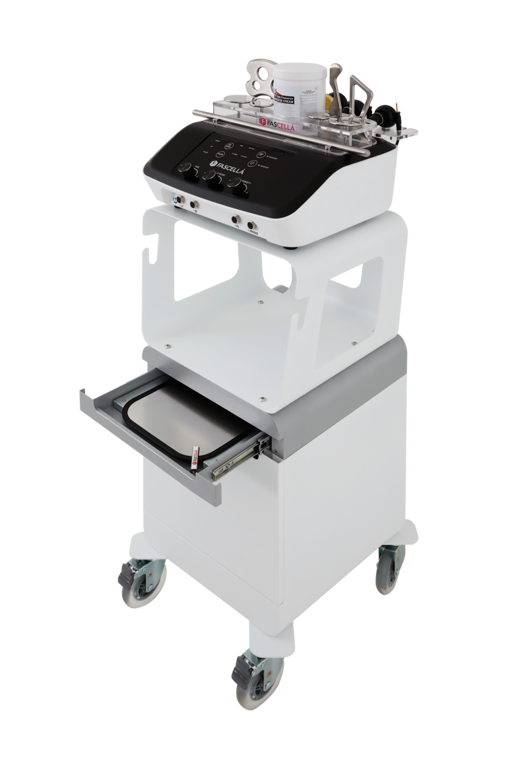
RF and LF Energy Delivery
The Fascella system combines radiofrequency (RF) and low-frequency (LF) energy to reach the deep fascia layer. These energies are delivered in a controlled and precise manner to stimulate tissue activity.
RF and LF energy contribute to:
- Activation of cellular function
- Stimulation of collagen production
- Promotion of elastin regeneration
- Support for tissue remodeling
This approach helps address the underlying structures that influence skin appearance and body contours.
MFR Tool Integration
Fascella incorporates an MFR (myofascial release) tool that works simultaneously with the energy-based treatment.
The tool moves smoothly across the skin surface while stimulating multiple structures, including:
- Fascia
- Cellulite tissue
- Lymphatic vessels
- Blood vessels
This combined approach allows the treatment to reorganize and realign fascia that has become adhered or irregular, helping restore smoother tissue alignment.
Reduction of Subcutaneous Fat Cells
Fascella energy also interacts with the subcutaneous fat layer, supporting the reduction of fat cells beneath the skin. This contributes to improved body contours and a more balanced silhouette.
Key Benefits of Fascella
The Fascella treatment aims to support multiple aspects of tissue health and aesthetic improvement.
Healthy Fascia Recovery
Fascia remodeling helps restore the structural balance of connective tissue, which plays a central role in maintaining skin firmness and smooth contours.
Improved Blood and Lymph Circulation
By stimulating blood vessels and the lymphatic system, Fascella supports improved circulation, which contributes to healthier tissue function.
Facial and Body Contouring
Through its effects on fascia and subcutaneous fat layers, Fascella helps refine facial contours and body lines.
Reduction of Cellulite and Stretch Marks
Stimulation of connective tissue and improved circulation may help reduce the visible appearance of cellulite and stretch marks.
The Medical Approach at Maison de M Clinic
At Maison de M Clinic, Fascella treatment is delivered with a focus on precision, patient comfort, and tissue-based care.
The clinic’s approach emphasizes:
- Addressing deep structural layers of the skin
- Supporting natural tissue regeneration
- Providing non-invasive treatment without anesthesia
- Encouraging balanced, natural-looking results
Rather than focusing solely on surface-level changes, the approach prioritizes underlying fascia health, which can influence long-term skin condition and contour.
Safety Standards and Patient Care Process
Fascella treatment is designed to be performed without anesthesia, significant pain, or major side effects. This allows patients to undergo treatment in a comfortable clinical setting.
During the procedure, energy is delivered precisely to target tissue layers while the device glides across the skin surface. The treatment stimulates multiple tissue structures simultaneously, including fascia, blood vessels, lymphatic pathways, and connective tissue.
Patient care typically focuses on:
- Careful assessment of skin and tissue condition
- Controlled energy delivery to targeted areas
- Continuous monitoring of patient comfort throughout the procedure
The design of the treatment supports safe and controlled stimulation of deep tissue layers.
Recovery and Post-Treatment Care

Because Fascella is a non-invasive procedure, recovery time is generally minimal. Patients are able to resume normal daily activities shortly after treatment.
The treatment’s effects are linked to gradual tissue remodeling, including collagen and elastin regeneration. As the fascia reorganizes and circulation improves, patients may observe progressive improvements in skin elasticity and contour.
Post-Treatment Considerations
After Fascella treatment, patients may focus on:
- Maintaining regular skincare routines
- Supporting circulation through healthy lifestyle habits
- Attending follow-up consultations if recommended by the clinic
These steps help support the natural regenerative processes activated during the treatment.
Long-Term Tissue Support and Maintenance
Fascella focuses on improving tissue structure from deeper layers, which may contribute to longer-term improvements in skin elasticity and contour.
By stimulating collagen, elastin, fascia alignment, and circulation, the treatment supports a comprehensive approach to skin and body contour care.
For patients seeking non-invasive methods to improve cellulite, skin elasticity, or facial and body contours, Fascella at Maison de M Clinic offers a treatment designed to work with the body’s natural tissue processes.
More Treatments
Explore additional Ultherapy Prime, Sofwave, Thermage FLX, skin booster, filler, and stem-cell treatments at Maison de M Clinic.

Two hands New Ulthera Prime
Two Hands New Ulthera Prime is a non-surgical ultrasound lifting treatment designed to improve skin elasticity, facial firmness, and symmetry.
Learn More

PTING Laser
PTING Laser uses ultra-high frequency microwave energy to deliver controlled thermal stimulation to deeper tissue layers.
Learn More

Sofwave
Sofwave is a lifting procedure that delivers concentrated ultrasound energy to the dermis layer at a depth of 1.5 mm using seven specialized transducers and SUPERB™ technology.
Learn More